Notary Bond Application:
X

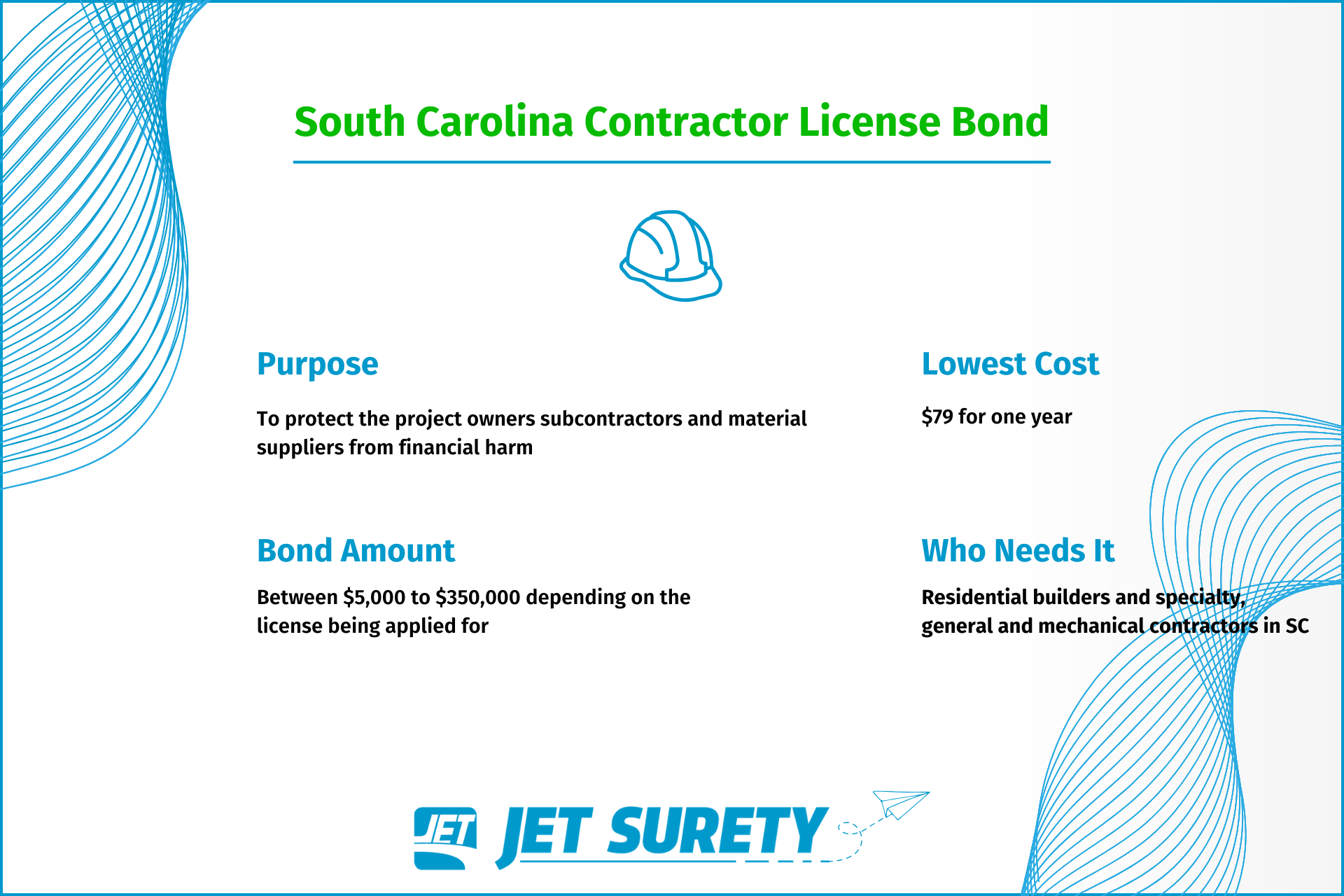
The South Carolina Department of Labor, Licensing and Regulation (DLLR) requires certain contractors to purchase a surety bond as a condition to obtaining a professional license. These bonds protect project owners, subcontractors, and material suppliers if a contractor violates the terms of a construction contract or fails to comply with applicable building codes and health and safety laws.
Click the below button to obtain a quote for your business.
Jet Surety provides qualified South Carolina contractors with the lowest market rates.
We employ industry specific underwriting standards that allow us to weed out the small percentage of bad applicants that cause all of the claims, ensuring reputable contractors do not overpay.
Don’t subsidize your competition. Get a quote today by filling out the above application.
Residential Builders and Specialty Contractors
The cost of the bond varies depending on the type of license you are applying for. Rates start at $79 per year or $8 per month for registered and licensed specialty contractors. For residential builders and firms applying for a Certificate of Authorization (COA), rates start at $105 per year or $11 per month. The cost of the bond is determined based on the owner's credit score and experience.
If you received a lower quote elsewhere, send it to us and we can likely beat it. Our goal is to offer every qualified contractor that passes our underwriting the lowest market rate.
| Bond Type | Monthly | 1 Year | 2 Years |
|---|---|---|---|
| $5,000 Registered Specialty Contractor | $8 | $79 | $138 |
| $10,000 Licensed Specialty Contractor | $10 | $79 | $138 |
| $15,000 Residential Builder | $15 | $105 | $184 |
| $15,000 Certificate of Authority | $15 | $105 | $184 |
Commercial General and Mechanical Contractors
General and mechanical contractor licenses are broken into tiers which limit the size of projects contractors are allowed to undertake. The cost of the bond depends on the license tier, the contractor's credit score, years of experience and financial standing. The below table illustrates Jet's preferred rates for South Caroline general and mechanical contractor bonds.
| Bond Type | Limit | Monthly | 2 Years |
|---|---|---|---|
| General - Group 1 | $20,000 | $18 | $315 |
| General - Group 2 | $60,000 | $52 | $899 |
| General - Group 3 | $150,000 | $125 | $2,175 |
| General - Group 4 | $250,000 | $274 | $3,979 |
| General - Group 5 | $350,000 | $329 | $5,755 |
| Mechanical - Group 1 | $7,000 | $7 | $115 |
| Mechanical - Group 2 | $15,000 | $13 | $219 |
| Mechanical - Group 3 | $30,000 | $28 | $489 |
| Mechanical - Group 4 | $60,000 | $52 | $899 |
| Mechanical - Group 5 | $300,000 | $279 | $4,875 |
All general contractor bonds expire on October 31 of even numbered years, and all mechanical contractor bonds expire on October 31 of odd numbered years. Prorated rates are available for contractors applying for licensure outside of the defined renewal periods that do not need a full two years of coverage.
General and mechanical contractors only need to purchase a bond if they do not meet the minimum net work and total equity requirements for the license tier they are applying for (more on this later) or do not wish to submit financial statements verifying this information to the DLLR.
Yes, contractors with poor credit are not automatically disqualified from obtaining coverage. Credit is just one of many factors we consider when underwriting South Carolina Contractor License Bonds.
Qualified contractors can choose to pay for their bonds on a month to month basis. Our monthly subscription option allows you to pay as you go, does not require a down payment and allows you to cancel at any time at no cost.
Residential specialty contractors and builders do not need to provide business financial statements as a prerequisite to obtaining a bond.
Applicants for a Group 3, 4 or 5 General Contractor License, or a Group 5 Mechanical Contractor License are generally required to submit business financial statements prior to receiving a bond. Due to the high limits and inherent risks associated with these bonds, surety companies prefer to review financials statements as part of the underwriting process to ensure contractors have the capacity to successfully complete the projects they undertake. For new businesses that do not have financial statements, surety companies will typically request personal financial statements for each owner.
South Carolina Contractor License Bonds protect the public from financial harm if the contractor fails to adhere to the provisions laid out within the bond form.
Residential builder and specialty contractor bonds protect homeowners if the contractor violates state building codes or health and safety requirements. For example, if a residential builder constructs a house with structural deficiencies, or if an electrical contractor enacts faulty wiring, then the homeowner that hired the contractor could file a claim against the bond (up to the full limit) to recoup any losses suffered as a result.
General and mechanical contractor bonds protect project owners, subcontractors and material suppliers from harm if the contractor fails to adhere to the terms of a construction project. For example, if a contractor abandons a job and does not provide a refund, then the project owner could file a claim against the bond. Additionally, if a subcontractor is not paid for work they have performed, or if a vendor is not paid for materials they supplied, then the subcontractor/vendor could file a claim to recoup their losses.
Unlike other types of insurance, contractors are required to repay the surety company for all valid claims and claims handling expenses.
South Carolina has different bond requirements depending on the type of license the contractor is applying for.
Residential Builders and Specialty Contractors
All residential builders operating in the state must purchase a $15,000 surety bond. Licensed residential specialty contractors (includes electricians, plumbers and HVAC contractors) that perform work on projects costing $5,000 or more must purchase a $10,000 surety bond.
Registered residential specialty contractors performing work on projects costing $5,000 or more must purchase a $5,000 surety bond. Contractors performing the following trades will need this bond.
Commercial General and Mechanical Contractors
General and mechanical contractors are only required to purchase a bond if they are unable or unwilling to submit financial statements to the DLLR verifying their working capital (current assets - current liabilities) and net worth (total assets - total liabilities). The working capital, net worth or surety bond requirements vary depending on the type of license being applied for.
| License | Maximum Project Size | Working Capital | Net Worth | Bond Limit |
|---|---|---|---|---|
| General - Group 1 | $100,000 | $10,000 | $20,000 | $20,000 |
| General - Group 2 | $400,000 | $40,000 | $60,000 | $60,000 |
| General - Group 3 | $1 million | $100,000 | $150,000 | $150,000 |
| General - Group 4 | $3 million | $175,000 | $250,000 | $250,000 |
| General - Group 5 | Unlimited | $250,000 | $350,000 | $350,000 |
If the contractor is determined to have violated the regulations governing their license, then the DLLR may increase the bond to an amount they deem necessary. If the contractor does not commit any license violations for a period of one year, then the DLLR will reduce the bond to its original limit.
| License | Maximum Project Size | Working Capital | Net Worth | Bond Limit |
|---|---|---|---|---|
| General - Group 1 | $100,000 | $10,000 | $20,000 | $20,000 |
| General - Group 2 | $400,000 | $40,000 | $60,000 | $60,000 |
| General - Group 3 | $1 million | $100,000 | $150,000 | $150,000 |
| General - Group 4 | $3 million | $175,000 | $250,000 | $250,000 |
| General - Group 5 | Unlimited | $250,000 | $350,000 | $350,000 |
The type of financial statements contractors are required to submit depends on the license tier they are applying for.
Group 1 and 2 license applicants that opt not to purchase a bond must submit an Owner-Prepared Financial Statement with their license application. Applicants for a Group 3 or 4 license must submit financial statements compiled by a licensed Certified Public Accountant (CPA), and Group 5 license applicants need to submit a CPA audited balance sheet.
When renewing their license, Groups 1-4 need only submit an Owner-Prepared Financial Statement and Group 5 licensees can submit CPA compiled financial statements.
Contractors that meet the working capital or net worth requirements for their license tier will need to weigh the pros and cons of qualifying via a bond or financial statements and make a decision based on their individual needs.
Group 1 and 2 licensees do not need to hire a CPA and can compile the Owner-Prepared Financial Statement themselves. Opting for a bond costs money, but saves the contractor time. Completing the financial statement may not necessarily cost the contractor anything, but it takes time to review financial data, compile it and obtain a notary signature.
For Group 3 and 4 licensees, the state requires CPA compiled financial statements. CPAs typically charge between $500 to $2,000 for this service and the turnaround time is generally between 1 to 3 weeks. The bond will cost around the same amount but can be obtained much more quickly.
Group 5 licensees are required to submit CPA audited financial statements, which can cost tens of thousands of dollars and and take months. A bond can be obtained in a fraction of the time it takes to complete an audit (within an hour of submitting an application) and typically costs significantly less.
If a contractor already has CPA prepared financial statements, then it usually makes more sense to use them to qualify for licensure. However, if a contractor does not have CPA prepared financials and does not need them for for reasons outside of applying for a license, then it will typically be cheaper and quicker to obtain a bond.
Contractors that do not meet the working capital or net worth requirement for their desired license tier need to purchase a bond to prior to receiving a license.
Residential builders and specialty contractors can file their bonds electronically via their license portal or email them to the Residential Builders Commission at [email protected].
General and mechanical contractors can email their completed bond forms to the Contractor's Licensing Board at [email protected].
Jet will send you a renewal quote prior to your bond's expiration date. Once purchased, Jet will provide you with a Continuation Certificate that must be submitted with your license renewal application.
All general contractor bonds expire on October 31 of even numbered years, and all mechanical contractor bonds expire on October 31 of odd numbered years. Residential builder and specialty contractor bonds do not have a common expiration date but can be issued in 1, 2, 3 or 4 year intervals.
South Carolina Contractors must meet multiple requirements prior to receiving a license, including obtaining the necessary experience, submitting an application and paying all required fees.
Residential Builders and Specialty Contractors
Residential builder and specialty contractor licenses are issued by the Residential Builders Commission.
Contractors are required to obtain a specific license/registration corresponding with the type of work they perform.
Residential builders and specialty contractors are required to obtain one year of relevant work experience within five years of applying for licensure. Applicants will need to submit an affidavit verifying their experience.
Residential builders must purchase and maintain a $15,000 surety bond. Electricians, plumbers and HVAC contractors that undertake projects costing at least $5,000 must purchase a $10,000 bond and specialty contractors that undertake projects costing at least $5,000 must purchase a $5,000 bond.
Applications can be submitted online via the Residential Builders Commission's licensing portal.
After their license application is approved, residential builders, electricians, plumbers and HVAC contractors will receive instructions on how to register for their license exam, which they must pass prior to receiving their license. Specialty contractors applying for registration do not need to take an exam.
Commercial General and Mechanical Contractors
General and mechanical contractor licenses are issued by the Contractor's Licensing Board and are required for individuals and businesses performing commercial construction work exceeding $10,000.
General and mechanical contractors must obtain specific classifications corresponding to the type of work they perform. Additionally, licenses are broken into tiers that limit the maximum project size contractors are allowed to undertake. A list of license classifications and tiers can be found here.
General and mechanical contractor licenses must be qualified by at least one individual that has the necessary knowledge and expertise to manage construction operations. Primary qualifying parties must pass the exams for the license classification(s) being applied for and have two years of relevant work experience. Primary qualifying parties can schedule their exams online here.
License applicants must either purchase a surety bond or obtain financial statements corresponding to the requirements of the license tier they are applying for.
Contractors can submit their completed applications to the Contractor's Licensing Board via email at contact.clb@llr.sc.gov or by mail to the following address:
PO Box 11329
Columbia SC 29211
Contractors must pay a $350 application fee.
Project owners may require contractors to obtain bid, performance and payment bonds prior to bidding on and starting work on a construction project. Additionally, many local municipalities have bond requirements for contractors obtaining to pull permits and perform work in their jurisdictions.
Contractors in need of construction or license/permit bonds can apply with Jet online here.

How to Renew My Bond
With Jet it couldn’t be simpler, just make payment. If you want to read more, you can.

How to Cancel My Bond
Email us is the simplest way and you can learn more if need be here.

Bond Claim Process
Contractors can avoid claims and if falsely accused get help. Read more here.

