Notary Bond Application:
X

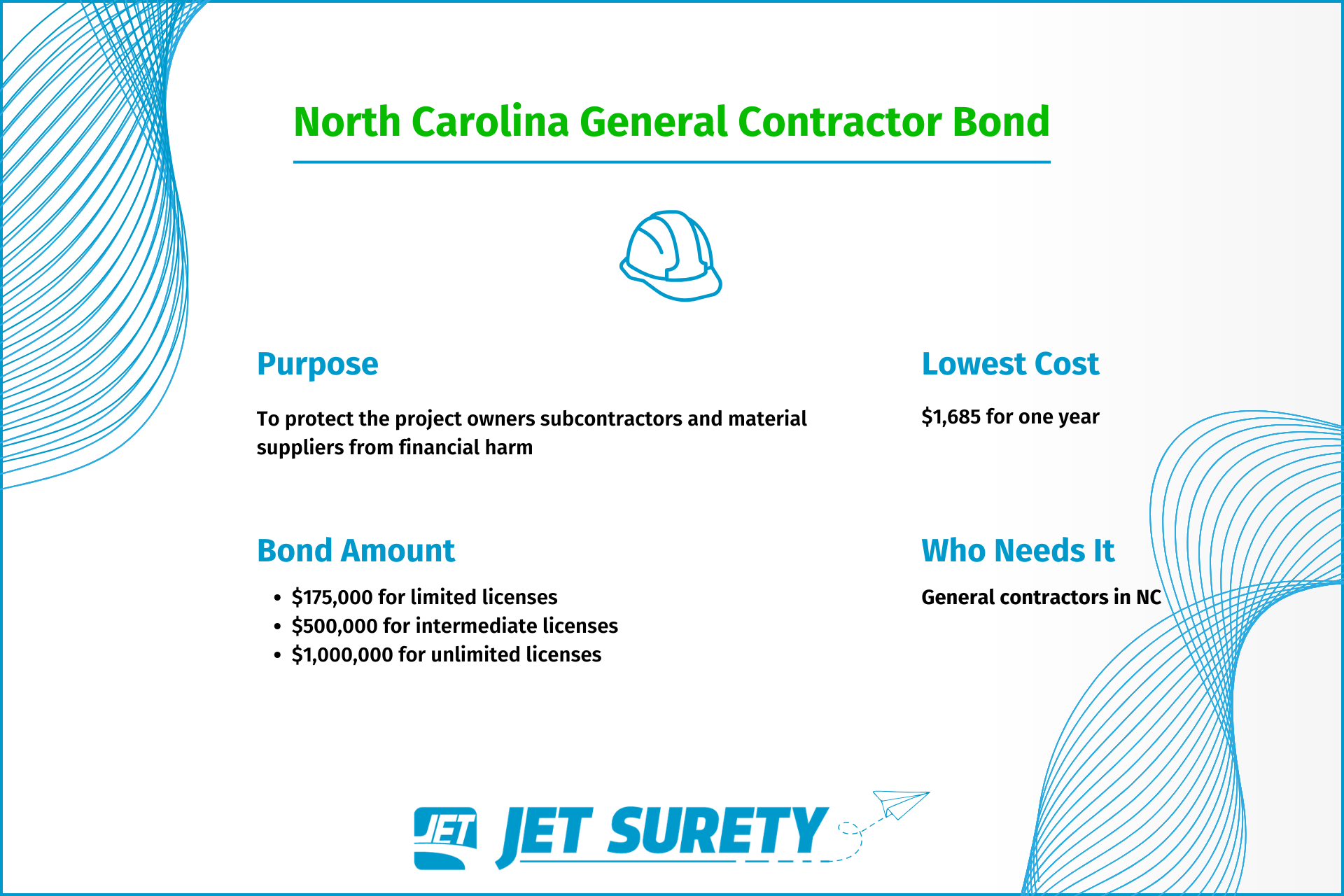
North Carolina requires general contractors to either submit financial statements verifying their working capital and net worth or purchase a surety bond. The bond protects the contractor's customers, subcontractors and material suppliers if the contractor fails to adhere to the terms of a construction contract. Depending on the maximum size of projects undertaken contractors need either a $175,000 Limited, $500,000 Intermediate, or $1,000,000 Unlimited Contractor Bond.
Jet Surety writes North Carolina General Contractor Bonds for as low as $1,685 for a 1 year term, or you can pay $169 per month.
We provide qualified North Carolina contractors with the lowest market rates.
Our underwriting goes beyond a simple credit check and a review of financial statements. We employ industry specific underwriting standards that allow us to weed out the small percentage of bad applicants that cause all of the claims, ensuring reputable contractors do not overpay.
Don’t subsidize your competition. Get a quote today by filling out the above application.
The cost varies depending on the license limit being applied for. Rates for limited licenses start at $1,685 for one year or $169 per month. For intermediate licenses, rates start at $4,850 per year or $489 per month. Lastly, rates for unlimited licenses start at $9,875 per year or $988 per month.
The rate is determined based on the owner's credit score and experience and the business's financial standing. If you received a lower quote elsewhere, send it to us and we can likely beat it. Our goal is to offer every qualified contractor that passes our underwriting the lowest market rate.
| Bond Type | Bond Limit | Monthly | 1 Year Term |
|---|---|---|---|
| Limited | $175,000 | $169 | $1,685 |
| Intermediate | $500,000 | $489 | $4,850 |
| Unlimited | $1,000,000 | $988 | $9,875 |
Yes, applicants with poor credit are not automatically disqualified from obtaining coverage. Credit is just one of many factors we consider when underwriting these policies.
Qualified contractors can choose to pay for their bonds on a month to month basis. Our monthly subscription option allows you to pay as you go, does not require a down payment and allows you to cancel at any time at no cost.
High credit applicants for a limited license are generally not required to submit business financial statements as a prerequisite to receiving a quote. However, doing so can lead to obtaining a lower rate. Due to the excess limits and underlying risk associated with the bond, applicants for intermediate and unlimited licenses are typically required to submit business (and in some instances personal) financial statements as part of the underwriting process.
Reviewing financial statements for intermediate and unlimited license applicants helps the surety company determine whether the contractor has the capacity to properly complete construction projects in excess of $750,000.
The bond protects project owners, subcontractors and material suppliers in the event the contractor fails to honor the terms of a construction contract. For example, if a contractor abandons a job and does not provide a refund, or if their work does not meet state and local standards, then the project owner could file a claim against the contractor's bond to recoup their losses. Additionally, if a contractor does not pay subcontractors or material suppliers for labor/materials used in a construction project, then the subcontractor or material supplier could file a claim against the bond to receive payment.
Typical payment and performance bonds cover a single construction contract, and the surety company is able to review the contract's terms when deciding whether or not to offer coverage. However, the NC General Contractor Bond acts as a blanket payment and performance bond covering all projects the contractor undertakes while the bond is active, drastically increasing the risk of claims. As such, very few surety companies write the NC General Contractor Bond and contractors oftentimes have difficulty securing coverage.
At Jet, we've created a unique program that employs enhanced underwriting in order to mitigate the risk of claims. This allows us to offer the lowest market rates to qualified contractors
As a condition to licensure, North Carolina requires general contractors to either purchase a surety bond or submit financial statements verifying their working capital (current assets - current liabilities) and net worth (assets - liabilities). As outlined below, the working capital and net worth requirements, as well as the type of financials that need to be submitted, vary based on the license limit.
| License Limit | Working Capital | Net Worth | CPA Audited Statements |
|---|---|---|---|
| Limited | $17,000 | $80,000 | No |
| Intermediate | $75,000 | N/A | Yes |
| Unlimited | $150,000 | N/A | Yes |
Applicants for a limited license must verify their working capital and net worth by submitting a self prepared balance sheet with their license application. However, if any owner or qualifier of the business is or has been in bankruptcy within the past five years, then the applicant must submit an agreed upon procedures report, prepared by a certified public accountant (CPA), or CPA audited financial statements. Contractors applying for an intermediate or unlimited license must submit either a CPA prepared agreed upon procedures report or CPA audited financial statements.
Depending on the company's size, obtaining a CPA audit can cost between $10,000 to over $50,000 and can take multiple months to complete. Obtaining a bond is typically cheaper than choosing to undergo an audit and takes less time (most applications can be quoted and issued within an hour). If a contractor already has CPA audited financial statements, then it usually makes more sense to use them to qualify for licensure. However, if a contractor does not have CPA audited financials and does not need them for for reasons outside of applying for a license, then it will typically be cheaper and quicker to obtain a bond.
Contractors that do not meet the working capital or net worth requirement for their desired license limit need to purchase a bond to prior to receiving a license.
General contractors can email their completed bond forms to the North Carolina Licensing Board for General Contractors (NCLBGC) at [email protected]. Once purchased, Jet will provide you with a digital copy of your bond. Before emailing your bond to the NCLBGC, you will need to print it off and sign it under the "principal" signature line near the bottom of the page. We will also mail you the original bond form with our raised seal. However, this does not need to be submitted to the NCLBGC.
The bond is continuous, meaning it does not expire unless explicitly cancelled by the surety company. However, contractors still need to renew their bonds with the surety company to avoid cancellation. Jet will send you a renewal quote prior to the end of your bond's term. Once your renewal is purchased, we will send you a renewal confirmation for your records, which does not need to be submitted to the NCLBGC.
General contractors in North Carolina must meet multiple requirements, including passing an exam, satisfying the financial responsibility criteria and completing an application.
The below steps outline how to obtain a North Carolina General Contractor License:
NC general contractor licenses are broken down into three distinct limits, which determines the maximum size of any single project (excluding the cost to purchase and improve the land) the contractor is able to undertake.
| License Limit | Max Project Value |
|---|---|
| Limited | $750,000 |
| Intermediate | $1,500,000 |
| Unlimited | Unlimited |
While virtually all contractors will instinctually want to apply for an unlimited license, each limit has unique financial responsibility criteria that contractors must meet to qualify.
Contractor's must obtain a license classification in line with the type of work they are going to perform. A list of license classifications, and their definitions, can be found on the NCLBGC's website here.
As previously mentioned, contractors must meet certain financial responsibility requirements depending on the license limit being applied for.
Limited contractors must demonstrate working capital of at least $17,000, a net worth of at least $80,000 or purchase a $175,000 surety bond. Intermediate license applicants must demonstrate, via audited financial statements, working capital of at least $75,000 or purchase a $500,000 surety bond. Applicants for an unlimited license must submit audited financial statements showing at least $150,000 in working capital or purchase a $1 million surety bond.
NC general contractor license applications are completed online via the NCLBGC's application portal.
After the NCLBGC approves the contractor's application, they will provide them with an eligibility letter with instructions on how to schedule the exam for the license classification being applied for. Contractors must designate a qualifier to take the exam. The qualifier must be a company owner, officer or employee and cannot qualify more than two licenses.
The NCLBGC must approve all new license applicants. After completing the exam, contractors will typically need to wait for up to three weeks before receiving approval.
North Carolina has additional state level requirements for landscape, irrigation and manufactured housing contractors. Many local municipalities have additional bond requirements as well. To obtain a quote on a North Carolina Contractor Bond, submit an online application or call our office at (855) 285-1264.
